Willows and sunsets belong together, but not by accident. A willow planted in the wrong spot becomes a dark curtain across the best light of the day. Planted with a little thought about height, spacing, and the angle of the evening sun, it becomes a frame: a soft-edged screen of leaves that catches gold along its rim while the sky glows behind it.
The difference between those two outcomes comes down to design decisions you can make on paper long before you dig. Where the sun actually sets. How low the branches hang. How much open sky you leave. This guide walks through those choices for a garden of any size, from a single weeping willow on a boundary to a small grove on a larger plot.
Before you look at a single plant, spend a few evenings in the spot where you plan to sit. Note where the sun disappears on the horizon in June, in September, and in December. It moves more than most people expect across the year, and a willow that perfectly frames a midsummer sunset may sit directly in the path of the winter one.
Useful habits for this survey:
Once you know the sunset arc, you know where the gaps must stay open. That is the first rule of this whole exercise: preserve the sightline, then decorate its edges.
A willow belongs at the side of the view, not in the middle of it. Set plants to the left and right of the sunset corridor, and leave the centre band of sky and horizon clear. Two willows flanking a view work like the uprights of a doorway — they direct the eye outward rather than stopping it.
Distance matters as much as position. A weeping willow (Salix babylonica) or a white willow (Salix alba) can throw a broad crown, and a mature tree close to a viewpoint will dominate it. Place larger willows well back, so their canopy sits lower in your field of vision and their tops do not cut across the glowing sky. Smaller shrub willows, such as Salix purpurea or the compact forms of Salix caprea, are better suited to the near edges either side of your seat.
Stretch a string between your eye level at the seating spot and the point on the horizon where the sun sets. Anything that rises above that line will block the sun itself; anything below it will frame. Stand at eye level rather than estimating from a plan drawing — the view from 1.2 metres up is very different from the view from a bird's-eye sketch.
Willows are thirsty, fast-rooted trees. Keep them at a sensible distance from drains, foundations, septic systems, and boundary walls, and check local guidance before planting close to any of these. If your soil is dry, willows will still grow, but they will grow more slowly and drop more branches in dry summers — which in turn means more pruning and a less graceful silhouette. A position where the ground stays reliably moist through summer suits them best.
Backlighting is the whole point of a willow at sunset. When low light passes through the foliage from behind, thin leaves glow and the fine twigs read as a drawing against the sky. To get that effect, you need light getting through the tree, not stopped by it.
Three things make the difference:
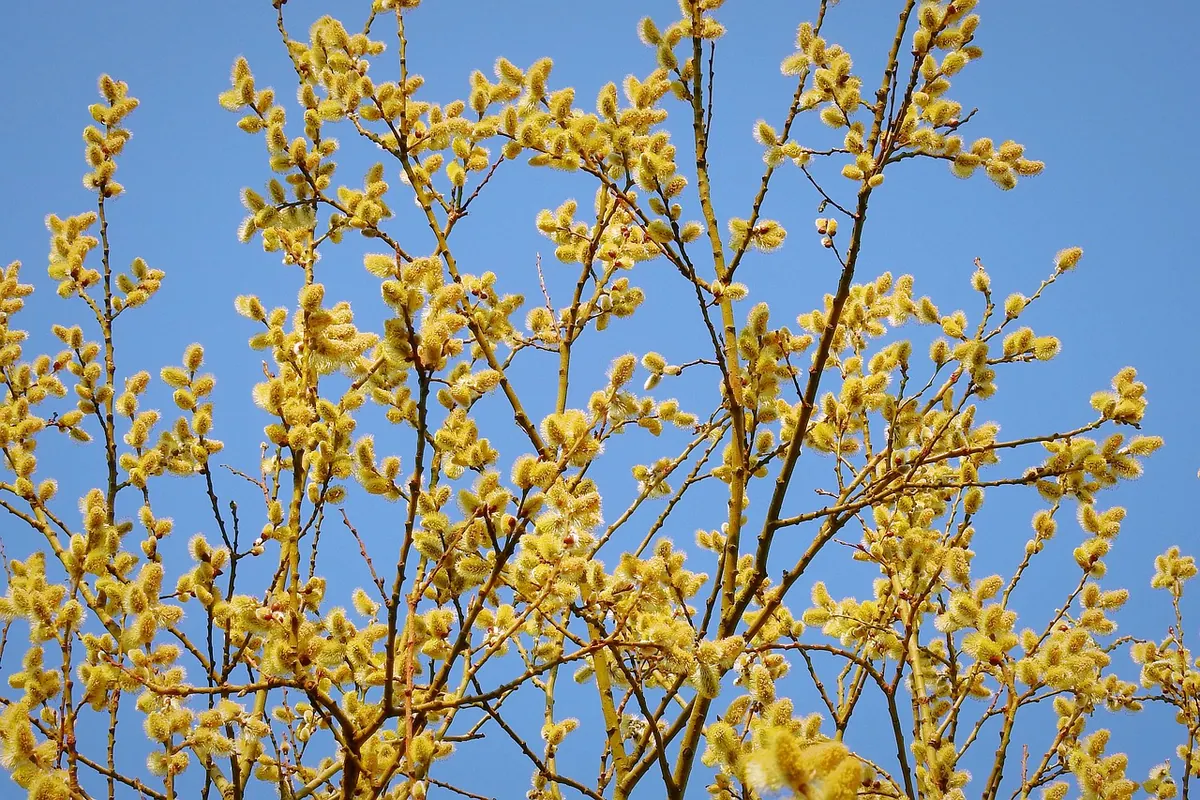
If you have a choice of species, choose one with finer foliage and slender leaves for the best backlit effect. Willows are naturally suited to this — the narrow leaves transmit light rather than blocking it, and the catkins in early spring add a second season of glowing edges before the sunset season even arrives.
A silhouette is a shape stripped of detail, and that makes it unforgiving. Every awkward stub and crossing branch shows. The good news is that willows have strong natural outlines — the upward arch of the branches, the hanging waterfall of a weeping form, the rounded mass of a pollarded crown — and those read beautifully in black against a warm sky.
Prune with the silhouette in mind, not just for size. Walk around to the viewing side at dusk and look at the tree as a flat shape. Anything that breaks the outline in a fussy way — a dead branch sticking out at an odd angle, a low limb that dangles into the view of the horizon — can go. Work gradually over two or three winters rather than cutting back hard in one go, since willows respond to heavy pruning with vigorous, upright regrowth that ruins a soft outline.
For a stronger composition, layer silhouettes at different distances. A shrub willow a few metres from the terrace, a taller willow behind it, and a distant hedge line beyond that will give your view depth, so the sunset feels like a space you are looking into rather than a backdrop stuck to the fence.
The view you design on planting day is not the view you will have in ten years. Willows grow quickly — often more than a metre a year in good conditions — and the gap you carefully left for the sunset will close if nobody intervenes.
Revisit the sightline every year or two, ideally in late winter before growth starts. Look from your main seat, at eye level, at the height of the setting sun. Trim back the willows that have encroached into the open band, and lift lower branches so you can see the horizon beneath the canopy. This is quick work — a few cuts with a pruning saw — but it is the difference between a view that lasts and one that disappears behind a wall of green.
On smaller plots, a pollarded willow at the edge of the view is a practical solution: it holds a compact crown at a height you control, gives excellent leaf silhouette, and is easy to keep out of the sunset corridor.
Keep in mind that the sunset is not always in the same place. The framing you build for June may sit differently in October, when the sun goes down further to the south and lower in the sky. A flexible design — two or three willows of differing heights, spread across a wide arc rather than clustered in one spot — will hold up through the year far better than a single tree placed precisely for one evening.
Allow a gap at ground level, too. Many of the best sunset views are horizontal: a low band of glowing sky beneath a canopy of hanging leaves rather than above it. Lift the skirts of your willows and keep low shrubs away from the outer third of the sightline.
Before you buy, do this: mark your sunset positions for the year, choose a seating point, and draw a line to the horizon. Place willows to the sides of that line and set larger trees further back. Choose narrow-leaved, finer-branched forms for the best backlighting. Thin the canopy rather than shearing it, prune for silhouette in late winter, and check the sightline every couple of years as the trees grow.
Then leave one evening free, sit down facing west, and see what you have made. A good willow sunset does not need much — a clear horizon, two soft dark shapes at the edges, and light coming through the leaves. The rest is patience.
Photo: MabelAmber / Pixabay