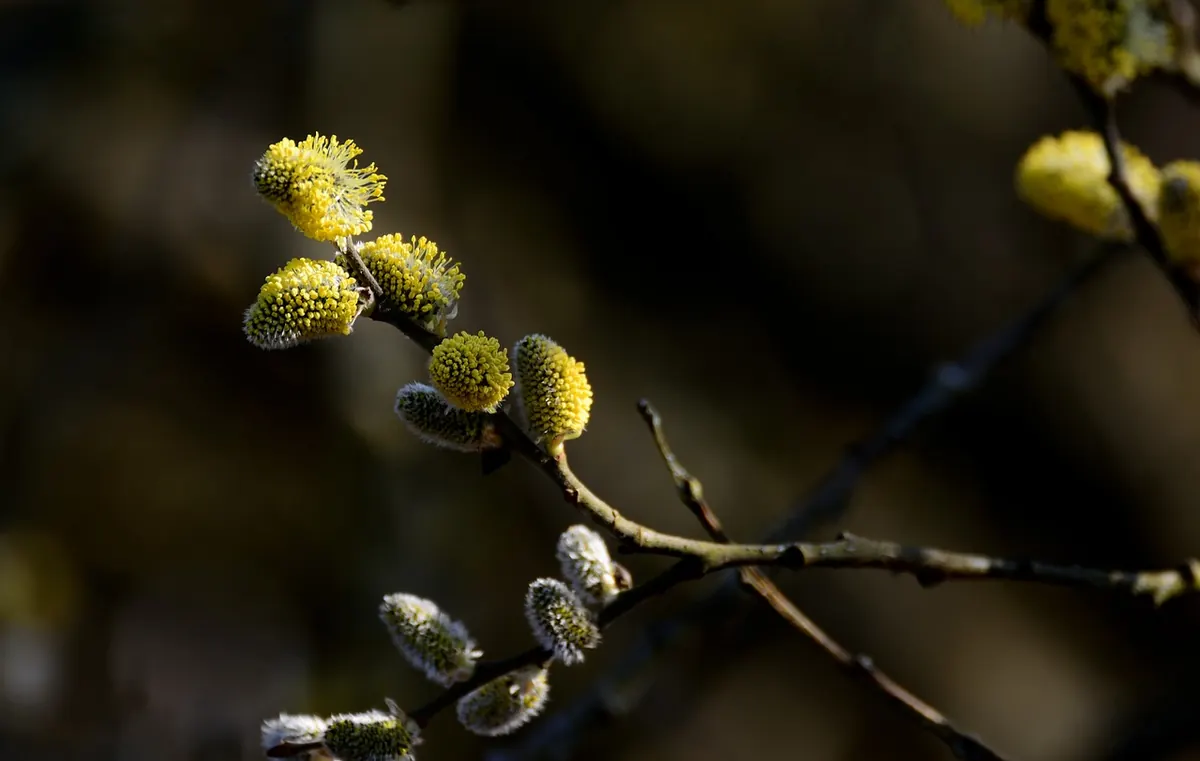
Willow has a reputation problem in small gardens. Most of us picture the weeping willow at the edge of a lake, or a wind-blown row of grey-green trees along a riverbank, and we cross the whole genus off the list before reading the label. That is a shame, because the family is far more varied than its big cousins suggest. There are willows that stay under two metres for years, willows grafted onto a straight stem to make a patio-sized lollipop, and creeping forms that knit across gravel without ever threatening the fence. Size, soil and what the plant actually gives you to look at are the three things worth comparing.
Willows are fast growers, and a good many of them are built to colonise wet ground in a hurry. So "compact" is always relative, and it helps to know which of three tricks you are buying.
The first is a grafted standard: a weeping or coloured cultivar is joined to a clear stem, and the height of that stem decides the height of the plant. The head stays small for years. The second is a genuinely dwarf species or cultivar, such as the creeping willow, which simply never builds much wood. The third is a vigorous willow that stays small only because somebody cuts it back every year, either hard in late winter or to a low hedge. All three work; they just ask different things of you.
Two practical cautions. A willow labelled dwarf may still spread wider than you expect, so check the spread as well as the height. And all willows are thirsty and hungry at the roots. Keep them a sensible distance from drains, soakaways and foundations, or grow them in a container where the root run is limited. None of them will sulk in wet soil, which is exactly why they suit awkward corners of a small plot.
The most useful willow for a small garden, and the one I would put in a pot by a door. The head weeps in a tight dome from a stem usually between 1.2 and 2 metres, so the plant fits a terrace without casting shade on the border. In early spring the bare stems carry grey, silvery catkins that open to yellow as the pollen shows. It takes any reasonable soil, prefers moisture, and wants full sun. Cut the long whips back after flowering to keep the dome dense rather than straggly.
The dappled willow earns its place on foliage alone: new leaves open pink and cream before settling to green, and the stems stay reddish in winter. Unpruned it will reach two metres and more, but an annual hard cut in early spring keeps it at about a metre and intensifies the colour, because the best leaves are on young growth. Full sun gives the strongest pink; too much shade and it turns quietly green. It also appears as a grafted standard, which is a neat way to use it in a narrow space.
A spreading Japanese willow grown for its catkins, which are rosy pink, upright and produced generously on bare wood in early spring. The habit is low and wide rather than tall, roughly 1.5 metres by 2, so give it room sideways and prune after flowering if it starts to sprawl. Grey-green leaves follow and the plant looks unremarkable by midsummer, which is the trade-off with catkin willows: a fortnight of real interest, then a quiet green shrub.
The dwarf purple osier is the willow I recommend most often for wet, heavy ground. Fine blue-green leaves on purple-red young stems give a soft, almost bamboo-like texture at 1 to 1.5 metres. It will take clay, standing water in winter and drier spells once established, and it clips well into a low hedge. Cut it to the ground every second or third spring to refresh the stems and stop it going woody and sparse at the base.
Rosemary willow is upright and narrow, with slim grey-green leaves that show a silver underside in any breeze. It sits comfortably in a crowded border because it takes up so little width, and the pale catkins in spring are a bonus rather than the main event. It is happy in ordinary moist soil and shrugs off wetter spots. Use it as a soft vertical among perennials, and trim lightly after flowering if you want to keep it tight.
A slow, low mound of broad, silver-blue leaves, with fat purple-black catkins in spring that look almost black against the foliage. At around 1 to 1.5 metres it suits a raised bed or a large pot. The one demand is drainage: gritty soil, full sun, and no winter waterlogging. If your soil holds water in January, plant it in a container of grit-and-compost mix instead and it will reward you for years.
The creeping willow is native to dunes and heaths, and it grows accordingly: 20 to 50 centimetres tall, spreading a metre or more, with small silver leaves and tiny catkins. It needs sun and sharp drainage, and it is the right plant for a gravel garden, the edge of a path or the front of a raised bed. Treat it as ground cover and it will earn its keep; plant it in boggy clay and it will fade within a season.
The woolly willow is an alpine from cold, stony ground, and its rounded leaves are covered in dense silver felt. It is slow, reaching about 1 to 1.5 metres over many years, with grey-purple catkins in spring. It wants grit, sharp drainage and full sun, and it dislikes winter wet more than cold. A collector's plant rather than a beginner's, but on a rock bank or in a trough it is genuinely striking.
Timing depends entirely on what you want from the plant, so decide that first and prune accordingly.
Match the plant to the job rather than to the photograph. A patio pot near a door: 'Kilmarnock'. A damp corner that nothing else enjoys: 'Nana' or rosmarinifolia. Best foliage colour in a sunny border: 'Hakuro-nishiki', cut hard each spring. Gravel or a rock bank: repens, or lanata if you have the drainage. Buy bare-root in autumn or early spring where you can, plant at the same depth it was growing before, firm it in, and water through the first summer.
Then be willing to cut. Every willow on this list stays small because somebody makes a decision with secateurs once a year. Skip that and even a dwarf will quietly become the tree you were trying to avoid.
Photo: Jerry Zhang / Pexels